Saturday, September 14, 2013

Suicide Kings


Back in August when news came of the first few salmon trickling into the Salmon River my focus on gold quickly turned to silver. In July and August I experienced the toughest carping ever. So the news of fresh chrome had me excited to say the least. After working twelve hours a day for six days, I hopped in my car for the four hour drive.. to fish for twelve straight hours on zero sleep. You got to do what you got to do...

I fished the DSR for two days straight where there were more people than salmon in the river. But none the less I had a fantastic time. The fish were few and far between and very spooky. My first day I swung the lower section hoping to locate a few fresh fish. Despite there being more people than salmon I still had entire runs to myself. I'd work my way down a run with one fly, walk back up and switch flies to do it again. Around noon I had lost all hope with the high sun and blue bird skies. I had only seen one fish move through all day. Since quitting is never an option while fishing, I swung on. It was around one o'clock when I felt it... Bump, Pull, Weight, Thrash... Holy Shit. My first king of the year grabbed a small pink comet on my first swing past a fishy looking log jam/undercut bank. After thrashing its way out to mid river it decided to go back to its holding lie. It streaked underneath the log and undercut and came back out at the top of the run with four of five other kings along for the ride, safety in numbers I suppose. I tailed the fish and gazed up and down river... Not a single soul in sight. It was magical. Later in the day I did find a small group of fish in a tailout that were so over worked through out the day they would scatter every time my fly swam past.

Day two I tried a different strategy. I started at the top of the "run" and worked my way down actually looking for fish instead to swinging empty runs and wasting my time. Its not as exciting as getting a take that your not expecting but I gave it a shot. There were ones and twos moving through fast water areas and staging in the tail out of the next run/pool. Since I had the river pretty much to myself again I watched these fish move up and let them rest in the tail out for ten minutes or so then I'd show them the goods. They were stubborn for the most part, ignoring my fly on every swing. Then there was a player. The fish tracked my wet fly for two feet or so my first pass at it. I got so pumped I shot another laser down and across and watched as the fish commit to my fly. I watched "the tug" from start to finish, it was pretty sweet. It was the only fish to commit on day two, but a one fish day is a good day.

See you on the river...


12' 7 wt. Cross S1 did some awesome work...


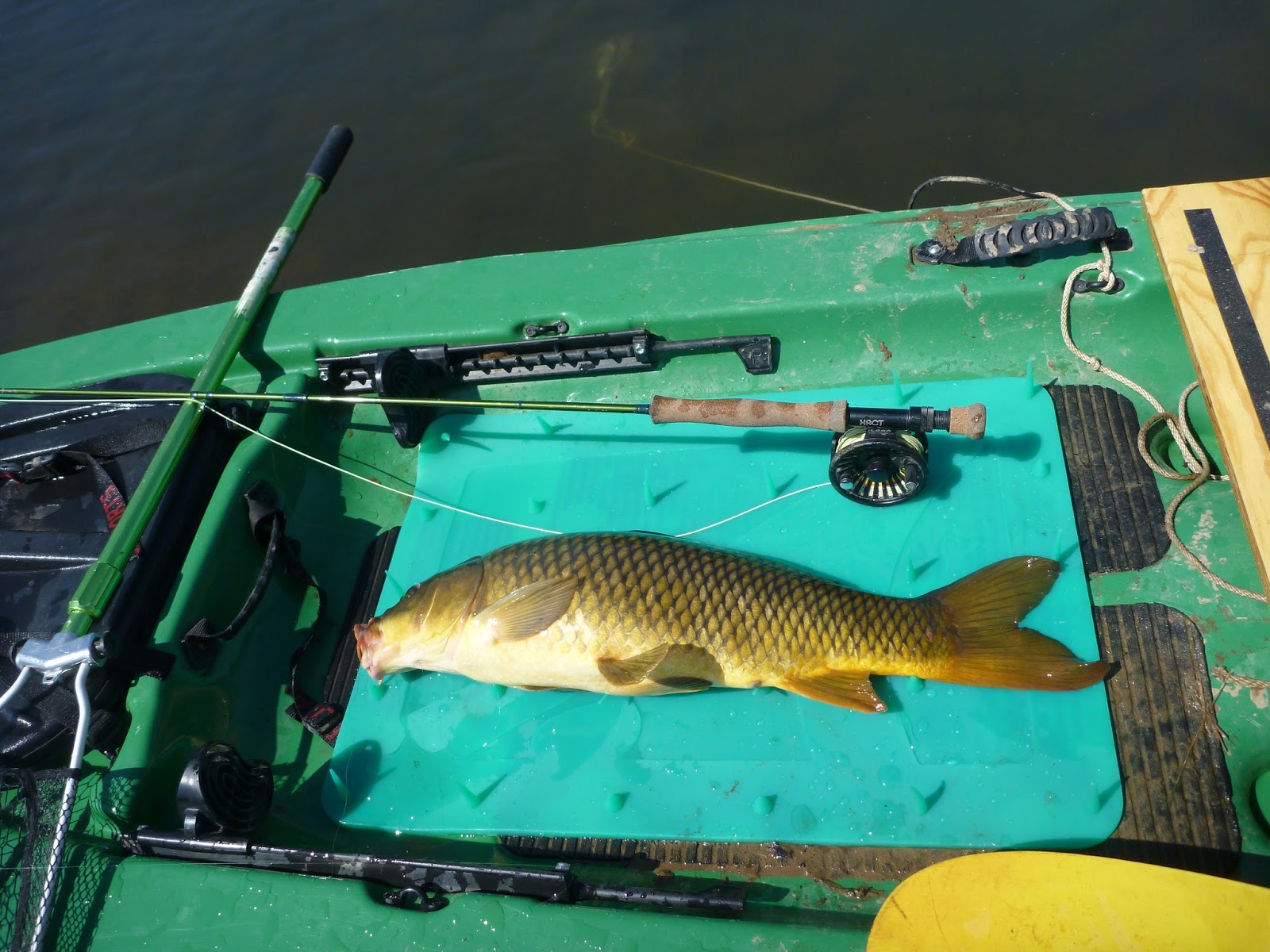
Judging by this fishes' mouth it was caught a dozen times out in the lake, but still willing to grab a gaudy wet fly.

Friday, September 13, 2013

Rubondo Island

With the collapse of the perch fishery imminent and inevitable, we figured we best try our luck as soon as possible. After all, from Dar es Salaam, Lake Victoria is easier to reach than Egypt's Lake Nasser.


Knowing that this trip was upcoming, my brother helped outfit me with some beefy fly gear. He loaned me his brand new Orvis Mirage V reel and Orvis Depthcharge lines in 300, 350 and 450grain weights. I paired that with a Loop Evotec 10wt of my own, that is really more like an 11wt.

Mark showed me how to tie the HangTime musky fly, and I tied a few for the trip. Mine paled in comparison to the gorgeous flies he tied with thoughts of musky dancing behind his eyes. He graciously loaned me a few of those, too.

Even with this gear, I was setting myself up for an ass-kicking. Fish between 60 and 100lbs are still pretty common. Unbelievable, a person trolling and staying in the same camp we were to stay landed a 93kg perch back in May. That's 205lbs, and they get even bigger.

For any larger fish that we might troll up, I had a Shimano TLD25 on an 8ft Penn Senator rod. For casting, we brought a Shimano Baitcaster 6000 on a 7ft Cabela's Saltstriker, spooled with 40lb braid. I had a box of huge Rapala-style lures that would allow us to fish anywhere in the water column. I thought we were fully kitted and ready to go.


Rubondo is the only island national park in Tanzania's park system. The forests covering the 175square mile island are almost entirely pristine. They were never, ever, logged. Most of the animals were introduced in the hopes of establishing something like a genetic Ark incase the Serengeti ecosystem was not preserved. There are elephants, chimps, a few species of antelope, bushpigs, giraffes, hippos and crocs present, as well as some huge monitor lizards and a host of other reptiles and birds.


The lushness of Rubondo conjured images of Jurassic Park in comparison to the deforested and eroded shoreline of the mainland. We were buzzing with excitement and anticipation as we approached the impenetrable prehistoric shoreline.


The only signs of life were thousands of snowy egrets flying low over the water and a boat anchored in a cove.


We came in low and hot to buzz the runway from east to west. We circled around a marshland thick with hippos and crocs to buzz the landing strip again. Pilots won't land on Rubondo until they're reasonably sure something like a bushpig won't lumber out onto the runway.


We spotted our lodge on the 2nd pass. We were to stay in a lakefront cottage, and head out for perch with Tanzanian Park Officers.


A stereotypical Land Rover was waiting for us in the "arrival, waiting and departure lounge". This family of bushpigs strolled across the runway a few minutes after landing. The largest was over 150lb.


We watched our ride depart from close range and turned towards the lake. We thought of the slammer perch swimming in the dark depths that we were soon to meet, in person. It was time to go fishing.


Again, Pete Stanley's excellent photography skills are telling this story as much as I am. Check his work out at www.photopoa.com

Tuesday, September 10, 2013

Manipulating Variables

""When we try to pick out anything by itself, we find it hitched to everything else in the Universe."  - John Muir

Imagine stocking one of the largest lakes on the planet, already lush with life adapted to its unique habitats, with an invasive eating machine capable of reaching more than 300lb.

Couple that with a surrounding population of desperate people, many living hand to mouth.

Add a dash of Russian, Chinese and European exporters taking the commercially harvested fish to markets in their own countries, without trading anything in return.

Sprinkle in some organized crime, both foreign and domestic, more than willing to exploit the desperation of local Africans.

Mix well, let ferment for 60 years.

The emergent stew is Lake Victoria today; a sick giant headed for some dark days.


Confiscated poacher's boats - Rubondo Island National Park

Nile Perch are native to the Nile River and its tributaries. Murchison Falls on the Nile is the geographic barrier that prevented the upstream distribution of the predators from entering Lake Victoria. In its isolation, Lake Vic evolved a host of unique fish; cichlids that diversified to fulfill almost every available niche.

Nile Perch were stocked in the 1950's to build the basis for a commercial fishery. The experiment worked too well. Considered a delicacy in Europe, Asia and Russia, giant, empty cargo planes began landing in Mwanza, a coastal village in Tanzania, filling their holds with refrigerated perch filets carved in foreign-owned processing plants, then flying home.

The introduction of the perch, and their flourishing, knocked the entire ecosystem out of balance. As the food web withers, an entire host of consequences have begun to rear. An even more dire future is forecast for the lake, but from the ruins a new ecosystem will, eventually, rise.

With the big money commercial fishery essentially collapsed, and the 'protected' waters of Rubondo Island National Park within sight of the mainland, desperate locals are lured into poaching by pay from foreign organized crime outfits, mostly from Asia. When chased, they stash their boats in the reeds and disappear into the forest. A night ride back to the mainland is a cell phone call away, and new boats are waiting for them to continue their poaching. If caught, they get bailed out by their employers after a stiff fine of 30,000Tsh ($18).


Poacher Patrol - While we trolled for perch, eyes scanned the horizons for signs of illegal activity.

Our park ranger fishing guide loved showing off his AK. On our first day, he begged us to let him chase some poachers we spotted in the distance. We chickened out, and had him drop us on a rocky outcrop while he gave chase. He returned with a shiny, new wooden boat full of nets. This happened two more times during our stay.

This game is relatively low-stakes. He's never fired his gun, and has never been fired upon. There are almost no consequences for getting caught, and he receives a 10,000Tsh ($6) bonus for each confiscated boat. It's just a game of cat and mouse.


The last thing most fish in Lake Victoria ever see: the gullet of the invasive Nile Perch.

The poachers use nets to capture remnants of the cichlid populations that used to dominate the lake. Each of the hundreds of species unique and endemic, they're now all but gone. If caught, they're used a bait.  Hooked through the back and connected to an unanchored water bottle float, they're set around the island.  Lines between bait and float might be 150ft long, and made of dacron. Perch can't resist, and find themselves connected to a buoyant bottle. If the bottle is seen, it will be hauled up and taken to mainland Uganda or Tanzania, usually for export to the EU or Asia.

The larger perch in the lake cannot be caught by the methods most locals use to fish the lake. Only the young perch are taken using gill nets meant for tilapia. With the demise of their main cichlid prey due to predation, the perch are turning on their own young, and small minnows known as daga. The bottom is dropping out of the fishery as we speak.


A croc with a bleak future. Note the netting entangled in its jaws.

Nile Perch have essentially eaten the tilapia and cichlids of the lake. The prey of those fish, daga, have expectedly exploded in numbers. This has led to a flourishing of snowy egrets, pied kingfishers, short-tailed and great cormorants; all predators of small minnows. The nile crocodile population had previously exploded due to the nile perch, but is now headed for collapse in time with the perch.

The loss of plant-eating cichlids has led to large-scale eutrophication of the lake's waters.

Tilapia were the staple of the diet of the peoples populating the shoreline. Tilapia meat used to be dried in the sun. Now, the fatty meat of the nile perch must be smoked or it will spoil. This has led to heartbreaking deforestation, for wood fuel, along almost the entire lake's shoreline.

Remember, though, that the nile perch fishery is closed to most locals because of the expense of acquiring nets that can handle the giant fish. Instead, they are given the carcasses of the fish that have already been processed commercially. Dumptrucks laden with heads and spines are dumped roadside, to be sifted, sorted and hung to dry in great, smoking arrangements.

The whole complicated thing is a total mess. The aquatic ecosystem is headed for total collapse. But, perhaps this a good thing, for only then will the lake be able to rebuild a new food web, adjusted for the presence of nile perch.

For more photos, check out Pete Stanley's photography website. A skilled photographer can give you a better sense of this part of the planet than a mediocre writer can.  www.photopoa.com
Saturday, September 7, 2013

An African Fishing Trip


Upon seeing that the school year would begin with a 5-day break because of Eid, the end of Ramadan, my first thought was "Where can I go fishing?" By chance, I stumbled upon some information regarding a species of huge fish that can be found, at least for the time being, in a relatively nearby body of freshwater: Lake Victoria.


There were four of us making the trip to Rubondo Island, the only island National Park of Tanzania. We are roughly half of the Science Department at our school in Tanzania. For one, it was his first fishing trip ever. For two, it had been a while. I was in charge of outfitting. We were going to troll huge Rapalas in the hopes of raising a beast. I also took a Loop Evotec 10wt, an Orvis Mirage V, some sinking lines and a box full of musky flies courtesy of my brother. What ensued was nothing short of adventure.


We caught some fish and we saw some sights that we'll never forget. We talked to people with incredible stories, and we learned a great deal about the struggles many people face to survive and the lengths to which others are will go to exploit their desperation. As science teachers, we experienced, in a very real way, the incredible complexity of ecosystems. We left with different eyes.


We were targeting invasive Nile Perch. Detonating a nuclear warhead in the lake would have probably caused less longterm devastation than the decision to stock these waters with these predators 60 years ago has done, and will continue to do.


I was optimistic about our chances of raising a beast while trolling, but less so on the fly. We went for it, regardless.


Bombing a 10wt with 450gr sinking line connected to an 8\0 Owner on the rolling foredeck of a wooden boat is an exercise in coordination akin to playing in a one-man band.


Over the next few posts I'll try to communicate the story of what nile perch have done to Lake Victoria and the people that depend upon its bounty. The incredible photography of Peter Stanley will help to tell the tale. Stay tuned.

Wednesday, September 4, 2013

The Calm Before the Storm


I laid awake, flanked by two spoiled labs, and unable to sleep. I slowly realized that summer was drawing to a close and the school year was about to commence. I wasn't worried at all about school. However, I was worried that I didn't fish as much as I should have over the summer. The hot doldrums of July and August had me trapped in a lazy funk full of late nights and extended periods of sleep. It slowly dawned on me that I fish more during the school year than I do when I have off for the entirety of the summer. It only took a few years, but its true. Priorities have a way of emerging the more your time is constrained. The school year forces me to fully take advantage of my days off and I am almost always fishing. The summer calm has me spending time with family and friends. I am recovering for the real season, where I work to live, rather than live to work. Summer is my calm, while the school year is my storm. 

As I arrived back in the area for another school year, I returned to my usual carp haunts to say hello to a few carp that I hadn't seen in awhile. They fully obliged and I satiated my fishing appetite for the time being. I even got the SUP out and into a few river fish on large crayfish imitations. There is nothing quite like sight fishing to carp to reinvigorate my soul for another school year of work and play. 


Sunday, September 1, 2013

Shenandoah Shin-dig

With a week to go before the wedding, a group of guys convened in Shenandoah National Park for the bachelor party. This place is an absolute gem and never disappoints, even if the weather is something less than cooperative.


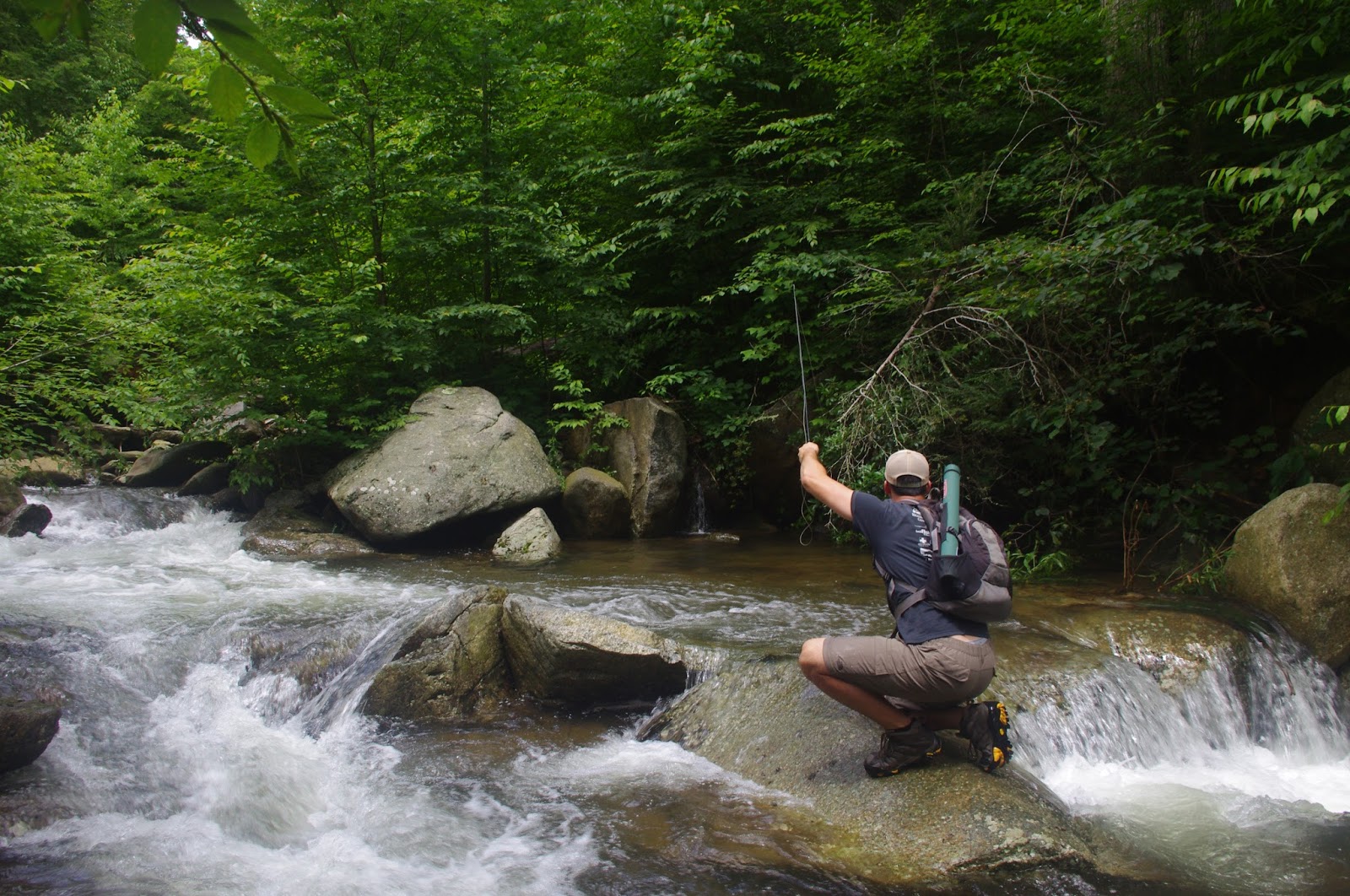
On the first night, we hiked down a well worn trail in search of a few brook trout. We found them, and took turns fishing the pools. Two friends received quick lessons and each was rewarded with an eager and beautiful fish on a dry. No matter where you are, the mood at a bachelor party is always thick with camaraderie and laughter. In the woods, this was no different.


We may have stayed down in the valley slightly longer than we should have, for the light was leaving the sky by the time we turned uphill. Half a mile from the trailhead, and it was full dark under the canopy of the trees. The forest floor was thick with bear-shaped shadows that kept us on high alert. Then, there was the scraping sound of claws on bark and one of those bear-shaped shadows began to lurch towards us.


A yearling scrambled up a tree not 20ft from us, while the mother bear at the base made her presence known, ears forward, neck outstretched, alert. With her cub in the tree, Skyline drive on her left and us on her right, her options were limited and we knew it.


Spot the brookies?


We ran back down the trail but kept the bear in our sight. It was too dark to take your eyes off of her, or you'd lose her. She walked towards the road, cutting off our planned escape, but began to circle back behind us. This forced us up towards the trailhead and out of her way.


It was too close for comfort, and the shot of adrenaline peppered the mood for the remainder of the night. We made for camp, started a fire, seasoned some juicy NY strip steaks, soaked some corn in their husks for the embers, and started in on the drinks.

Just as the steaks approached medium-rare, it began to rain. I tried to shield the steaks using a rain jacket, but was soon overwhelmed. We took shelter under the rain fly of my brother's hammock, thoroughly buzzed and soaking wet, in the dark.

It began to rain harder than I have ever seen it rain in this part of the states. It was like a tropical storm. Our downhill campsite was quickly overrun with ankle-deep water, and our tents were inundated with muddy runoff. Someone ran out for a steak and came back drenched, passing the steak between hands like a hot potato. We passed one steak around at a time, taking a bite passing it on. It was the best steak I'd ever had.

We took turns going on steak runs until we put all four of them down, still huddled under the rain fly. After 2 hours of keying in on the frequency of the raindrops, hoping for a decrease and not hearing it, we surveyed our utterly ruined campsite and decided to abandon hope. We made for the truck, uphill through shin deep runoff. Flipflops were torn off in the torrent never to be seen again. Foolishly untied Chuck Taylors were swept away into the darkness. It was unbelievable. By the time we reached the truck, we'd been swimming and not been as wet.


Two of us slept in the cab, while two huddled in the covered bed of the truck. We had no dry clothing left, and it was cold. Condensation dripped from the dashboard knobs and puddled in the window seams. The night passed fitfully, and when we awoke in the morning, it was still raining.


We resolved to tough it out, only because the campsite had working laundry facilities. A dry change of clothes changed everything.


The high water wouldn't last, so we waited a day for it to drop to fishable levels and went in search of some bigger fish that might come out to play in the higher flows. We found a few, but no slammers.


A day later, more people arrived for the climb of Old Rag. At about 9 miles, it's an uphill slog ending with an impressive rock scramble before you summit to 360 degree views of the Virginian Appalachians.


On the last day, we realized we were close to some fabled waters; The Rapidan. We scouted a trail and decided to hike down to the presidential retreat at the headwaters from Skyline Drive.


It was pretty interesting to see the information on display about the history of the place. The river was not very accessible below the retreat, but we bushwhacked our way to the stream.


We've heard the Rapidan receives quite a bit of pressure, so we employed stealth and longer, lighter leaders of 7x. We landed a few gorgeous fish and fished a lot of nice looking holes without success before turning uphill and returning to the truck.


This was not the Rapidan I had envisioned in my mind. I was expecting a larger stream, and maybe it becomes one further downstream, but we didn't have the time to explore more than a mile down from the headwaters.


We split the fish caught between dries and droppers pretty evenly.


Those few days in Shenandoah will be unforgettable. From the deluge that ruined our campsite, to the incredible campfire food and drinks, to the rivers and the wild trout that reside in them and the great friends and my brother that spent those days there with me, it was one hell of a time.