Showing posts with label Fly Presentation. Show all posts

Sunday, July 28, 2013

Flipping, Pitching, and Stack Mending your Tippet: Carp Tactics for Weedy Stillwaters


In my former days flippin’ & pitchin’ was done with 3/8 to 1/2 ounce jig and pig combos. Over the years I've been doing it with a fly that weighs only a few milligrams. Who would have thought that some of my old bass fishing tactics would help me catch carp?

For those of you who don't know what “flipping and pitching” is, it’s an underhand swing which propels your fly swiftly and accurately to a given target. As for “stack mending”, if you’re a seasoned trout fisherman you already know what this is and are very good at it. When trout fishing, stack mending is typically used to create or extend a dead-drift when fishing across an area of mixed current. For example, when nymphing a slow seam on the edge of fast current you would throw tiny roll cast like mends into the slow seam thus "stacking" your line. This slows down your drift and as the stacked line unfolds in the current it maximizes the length of your drift before the current produces drag on your rig. Now that’s enough silly trout talk…

In the summer months my stillwaters become thick with weeds. The only way to successfully target carp is to incorporate flipping and pitching into my casting repertoire. This is executed at very close range, usually within a few feet. Although once proficient you can successfully and accurately drop your fly on targets as far as fifteen feet away with little effort. Accuracy is very important when it comes to this technique, most of the time I’m flipping my fly into an area that’s only a few inches in diameter. If the target is very close to you stack mending is usually not required but the further you are from your target stack mending becomes crucial to present your fly to the fish. 

Let’s say you successfully creep to within fifteen feet of a carp feeding/cruising under dense surface vegetation. You will need locate a hole/pocket in the weeds and time your flip/pitch as to intercept the fish and present your (weightless) fly on the drop. In other words, make sure the fish sees the fly parachute to the bottom because after the fly hits the water you don’t apply any additional action to the fly at all. Once you've successfully flip/pitched your fly into an opening in the weeds that is any distance greater than a rod length away you’ll need to stack mend your tippet on top of the opening. This needs to be done constantly to allow the fly to free fall to the bottom. If you don’t stack mend your tippet the fly will hang in weeds well above the fish and you'll miss your chance. This type of mending must be done delicately as not to create ripples on the surface, any sort of disturbance will send my fish in the other direction. Also, knowing when to set the hook is dictated by your sixth sense because nine times out of ten you will not visually see the fish eat.  

As with any new technique, practice makes perfect. It can be extremely frustrating even once proficient. More often than not when you accomplish that perfect flip and mend a sunfish will be right there to blow your chances at gold. Keep your head up and stay with it. You will eventually be rewarded.    


My weapon of choice for flipping and pitching... 
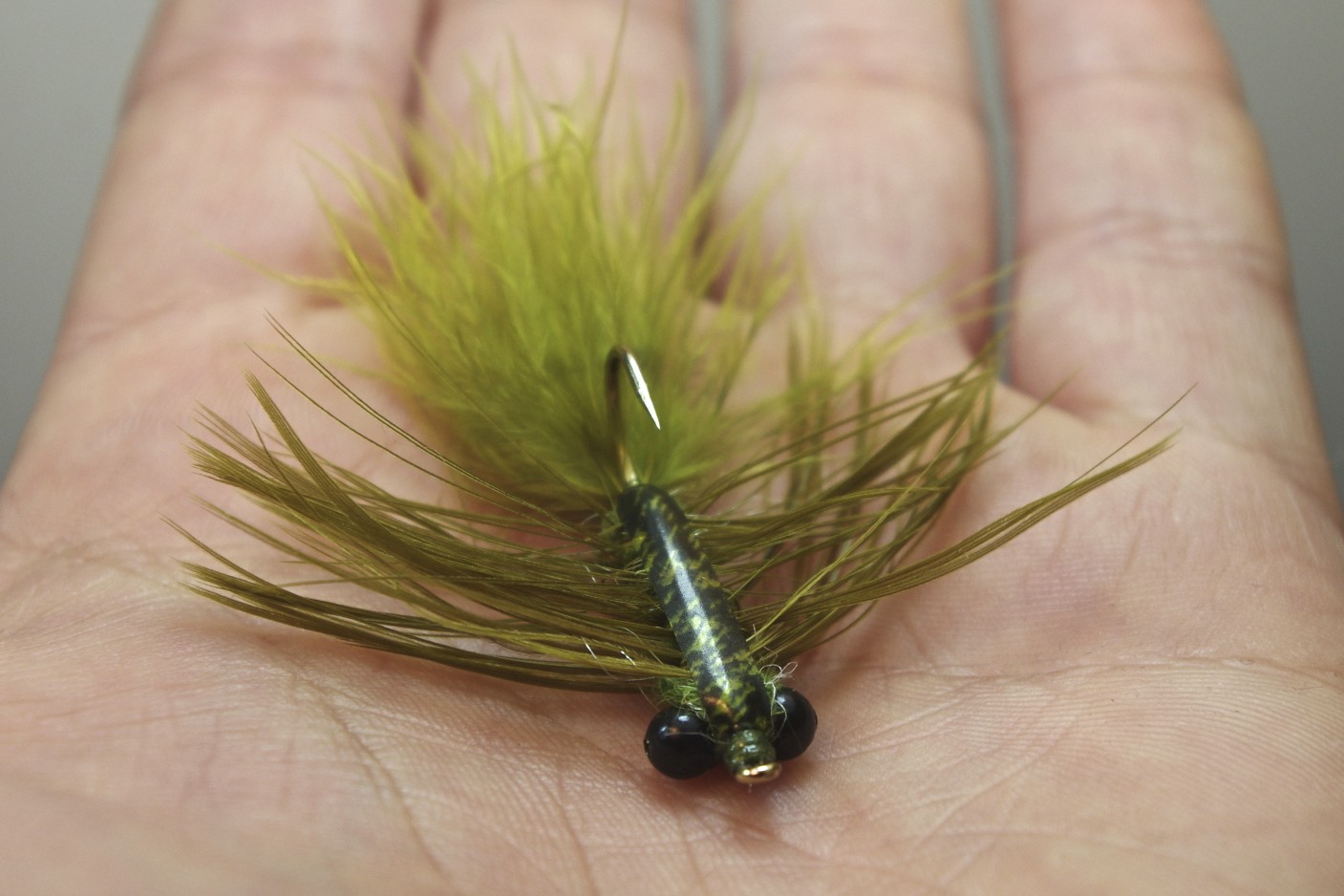
A Carp Damsel tied on a Gamakatsu split shot/drop shot hook.


Even this scenario calls for flipping and pitching...
Notice all the small pieces of weedy debris floating on the surface. Although it looks like open water, a weightless fly will not sink to the proper depth if your tippet is lying in surface debris.   


How many carp do you see?


Carp Dragons are another excellent choice. They tend to hold more water and break the surface a bit harder but once you get the hang of flipping you can slow down the entry of the fly, reducing the risk of spooking fish in shallow water. They are also bulkier than the damsel, they create more drag in the water which makes it easier to stack mend your tippet without pulling the fly upwards in the water column.


This is a carpers worst nightmare...
Venues with thick weed mats that consume the entire water column are still fishable if your're willing to go for a swim to untangle and dig up your fish.


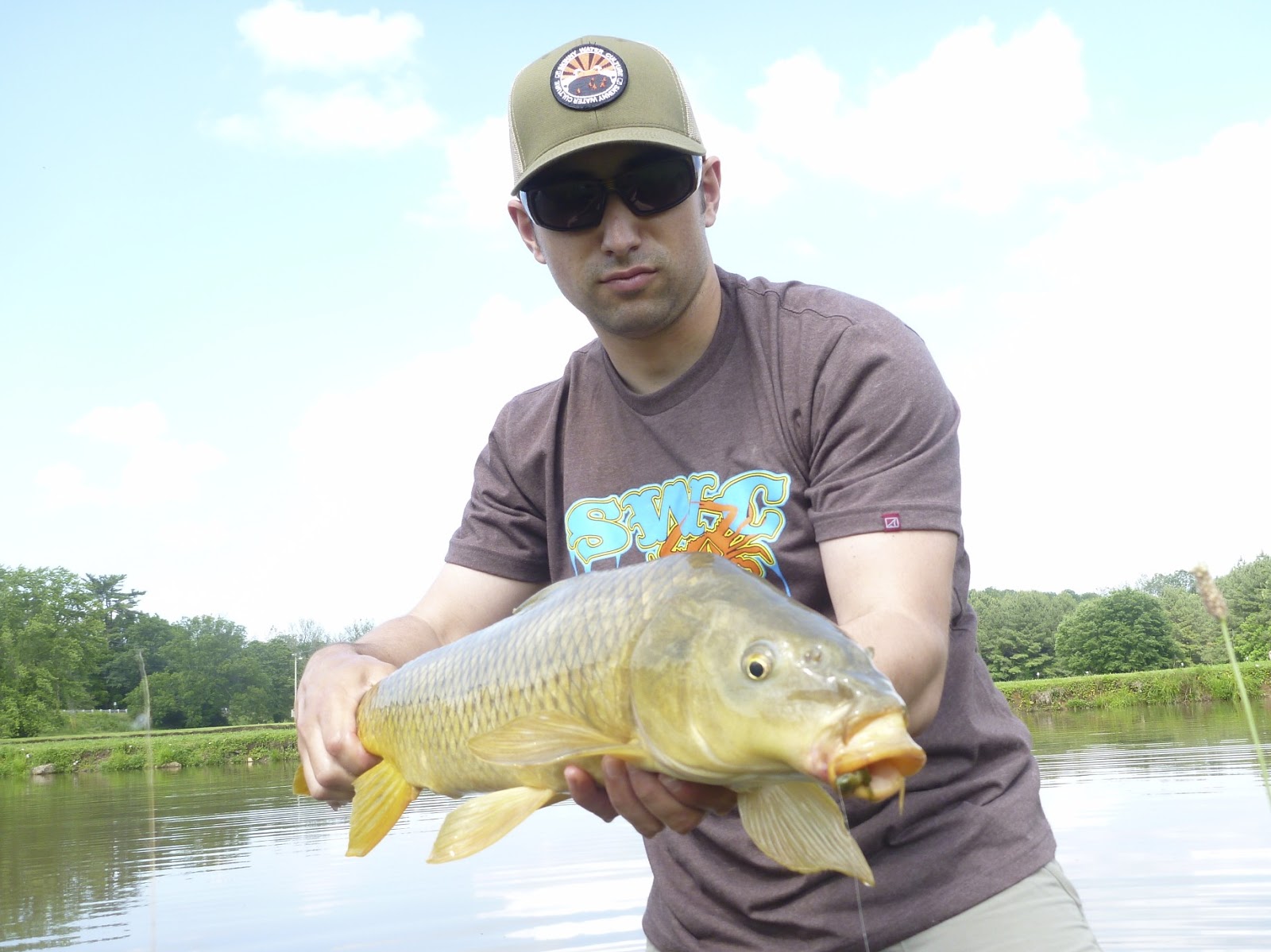
Victory in Vegetation! 

Friday, July 12, 2013

#mulberrytime


The first week of June usually signals the beginning of that special time of year. Mulberry time. The mulberries are now ripe enough to attract the attention of hungry birds and squirrels. Usually multiple squirrels and a variety of birds can be found in a mulberry tree at any given time. They feed on these berries quite aggressively because the unripe fruit is hard to pull from the tree. Due to their violent pulling and shaking of the branches they knock down as many berries as they eat, if not more. These berries fall into the water below and are quickly located by cruising fish. Carp will congregate underneath these trees to take advantage of this plentiful food source. Dry fly fishing is a blast and a welcome change of pace. Throughout the month I concentrated my efforts at a tiny retention pond which is home to a army of small fish. Size doesn't matter to me when they are eating my fly off the surface. I caught dozens of fish but one in particular was quite special. I caught the same grey and white linear mirror as I did last year. An absolute stunner. It was a nice surprise.

Even though the fish were small, casting accuracy was a must and extremely difficult to achieve. This made the small fish 100x more rewarding than they should have been. The fish fed heaviest underneath a section of very low hanging branches, a few even touching the surface. Shooting your fly down and under these branches from across the pond was a feat in itself. It was a game of inches. The fish are smart enough not cruise open water in search of berries because the berries don't drift away from the tree in stagnant water. This was especially true on sunny days where they felt safest in the shade of the tree. Towards the end of the season there was more flies hanging in the tree than actual berries. No risk, no reward.  

Although the dry fly action was hard to beat, I did crave bigger fish. Over the course of the month I fished other venues in search of larger fish. Sadly no mulberry trees are present at these venues. I had to go back to the basics and fish weightless nymphs at close range to weary fish. I was rewarded with a few decent specimens but I really had to work for them. These fish feed heaviest during low light conditions which makes sight fishing difficult. To combat this I incorporate large chartreuse eyes on my dragon and damsel patterns. This modification makes them a lot easier to see as they parachute down in the water column. Also, since I do the majority of my fishing in low light I made the switch back in January from amber polarized lenses to yellow lenses. The light yellow color greatly increases visibility.


Not close enough...


Just a few inches closer does the trick.


Unripe Mulberry


One...


Sexy...


Fish.


Micro


A blurry gator.


Sometimes you have to rest them on your knee...


The Damsel.


Carp Damsel tied with chartreuse eyes, responsible for all my larger fish


Carp Dragon doing work too...


Sunday, June 30, 2013

Muddy Water Carping


With the heat of summer upon us, it is also time for that annual threat, the severe thunderstorm. Looking at weather forecasts, it seems as if thunderstorms are expected to occur every single day. They come quick and dump an inch or more of rain in a few short hours. For trout streams, this is replenishment. To a warm water angler, this muddies things up a bit. Fishing the shoreline for carp usually improves, and you might even be lucky enough to fish a flooded area for a carp. For those of us that depend on sight fishing in clear water, things can get a bit tricky, especially for those fish feeding in the middle of a body of water. These techniques will help you to catch carp in muddy water while helping you develop a sixth sense.

During my first few years of targeting carp on the fly, the preferred strategy in muddy water was to throw on a strike indicator. Although a reliable option in certain circumstances and excellent at detecting a take, indicators also detect any contact with the line or fly. A take and a bump register the same way to an angler and in my experiences it can result in a lot of foul hooked or snagged fish. My technique began to change as my experiences molded a sixth sense, or ability to sense a take without actually seeing it occur. Since, I have come to rely on my sixth sense whenever targeting fish in muddy water.

In order to accomplish catching carp in muddy water, one needs to pay careful attention to the feeding activity of the fish. In high, muddy water, carp let their guard down and go on the feed. You'll often find them in places that they normally will not be. Since carp are almost impossible to see feeding in muddy water, you'll have to spot them by finding the evidence of their feeding. This most often occurs by spotting a mud trail or a steady plume of bubbles. Once spotted, you need to determine the direction that the carp is facing. This requires careful observation of their feeding movements and mud plumes/bubbles. If the water is shallow enough, you may even get a glimpse of a tail which is a clear giveaway. Once you see which way they are facing, look for a pattern. Are they staying in one spot, slowly making their way up a linear path, or going any direction they want? The latter is the most difficult to catch, but the first two are catchable.

Once you spot and observe the fish, the next step is the presentation. Whether you are tossing a stationary bottom fly, a mid-column fly, or a fly fished on the bottom, you can read the take the same way. When fish are actively feeding on  the bottom, they have their mouths in the muck and their senses are clouded by their disturbance. Once they are done, they will stop, pause, and continue, or they will move to a new spot to feed again. During these exchanges, when the fish stops or moves, is when they are susceptible to a fly. For this reason, I like to present my fly on the bottom, about 1-2 feet in front of the actively feeding fish. When the bubbles or cloud of mud stop rising from the bottom, you know the fish has paused or is looking to continue elsewhere. There is a few seconds of opportunity here when the fish will eat your fly.

If you are fishing a stationary bottom fly like a sucker spawn imitation your sixth sense is a prerequisite. Once the bubbles/mudding stops the fish can be on your fly. Usually there is a 1-5 second window where the carp can suck in your offering. If I think the carp is on the fly, I will tighten my leader/tippet and give a slow strip-strike. If this misses, I'll rarely spook the fish and since its slow, I am definitely not going to foul hook one. I will then wait until the fish begins mudding again and repeat the process. If  the slow strip strike is a success, I will continue the slow strike and the carp will feel the tension, bolt, and hook themselves.

If you are fishing a mid-column or bottom fly that requires action, the presentation is the same. Have the fly on the bottom or in the column at the moment the carp stops feeding. Give a short strip and pause to get the carp's attention. While rooting in the bottom, carp disturb aquatic invertebrates and will hunt them down. Having your fly flee the carp when he emerges from mudding is highly representative of the movement of its actual forage. In this case, you will feel the take after the strip.

Muddy water carping is not easy. A lot of time on the water and fly fishing for carp is needed in order to be able to read the body language of these fish and develop a sixth sense. The aforementioned strategies here are higher level techniques that can be very effective once mastered. They require a lot of patience, accuracy, and an acute awareness of carp behavior to work well.

Good luck.


Wednesday, January 9, 2013

Carp Flies 2


Adam's Fly Box: Out of pure respect, all my flies are barbless...


(#10 TMC 5263)

This fly is my go-to pattern. Over the years it has proved to be my top producer. Everyone has their “confidence fly", and this is mine. It’s a weightless rendition of a damsel or dragon fly nymph. I’m able to target feeding, cruising, and laid up fish with this pattern, making it very versatile. I fish this fly to mudders’ and cruisers by leading the fish at an estimated distance so that the fly has time to slowly parachute down in the water column directly into their line of vision. I fish the fly with no additional action what so ever. I just allow the fly to free fall to the bottom. This fly is best fished with a loop knot to insure it falls unrestricted and perfectly horizontal in the water column. If their interested and willing, they’ll meander over and grab it…if not they’ll ignore it. If ignored, the fly is non-intrusive so the fish will usually not be alarmed by its presence, allowing another cast to be made. Also, if ignored don’t think they haven’t seen it, they have excellent vision. As for laid up fish, I fish this fly with an 18+ foot leader insuring that my fly line lands nowhere near the fish. I will over shoot my target, but never directly over top of it, always at an angle to one side or another. Once the fly lands I will SLOWLY strip the fly into the fishes line of sight, never directly up to the fish itself, remember, they have excellent vision. I will bring the fly within three or four feet of the fish at eye level and then let the fly free fall. Like I said before, if their interested they’ll come and get it. If not try again. If you bring the fly up on the fish too close or too fast you’ll never get a second chance. Laid up fish are my favorite because there is so much room for human error. Challenge Accepted.   


Assorted Damsels
(#10 TMC 5263)


"Hover Damsel"
(#10 TMC 5263)

This pattern is just a modified damsel. Instead of scud back I tie it with craft foam. If I’m in a situation where the majority of fish I’m targeting are laid up, I will use this fly. The foam back modification allows the fly to free fall slower than my original damsel, giving the laid up fish more time to make a decision.


"Articulated Damsel"
(#10 TMC 2457)

The articulated damsel is another spin off my original. I’m always looking for a slightly new profile to show the fish because the small populations of carp I fish for become conditioned to a certain pattern after awhile. All it takes is something a bit different to rekindle their interest. 


Articulation does the trick


"Carp Dragons"
(#8 Daiichi 2451)

Unlike my damsel pattern that I created to resemble either a damsel or a dragon fly nymph. My dragon pattern is a more species specific rendition of a dragon fly nymph. Like I said before, fish populations will become conditioned to a certain pattern overtime. This one really saved me in the latter part of 2012. This pattern is also weightless and fished in the same manner as the damsel. It free falls slightly angled, nose down. Exactly like a fleeing dragonfly nymph trying to reach the safety of the benthos. A perfect target for a prowling carp.  


Dragon
(#4 Owner Mosquito)


One can't resist a fleeing dragon


Damsel
(#8 TMC 7999)


 Damsel
(#10 TMC 2457)


This open water cruiser fell victim to a damsel presented mid-column 


Damsel Variant
(#10 Gamakatsu SL45) 


Various Crayfish Patterns
(#4 Gamakatsu SC15)


(#6 TMC 2457)


"Temptation"
(#10 TMC 105)

This concoction is a unique attractor pattern I whipped up while bored one night. As crazy and outlandish as it looks, it actually works. I fish this fly as I would the damsel, leading the fish and letting it slowly sink. If they don’t see it, there is a good chance their blind, haha!


"Quick-Sight Jumbo Spawn"
(#4 Gamakatsu SL45)

This pattern I use on occasion when I have to present a fly at an insane distance. It's a simple sucker spawn with an opaque bead secured in the center. The pattern is large, bright, and sometimes terrifying. The bead acts like a parachute post on a dry fly, giving it excellent visibility. Making it easy to see when the fish eats. This pattern will only work a few times on a specific body of water before each and every fish knows whats up. 


This pretty much sums up the entire contents of my fly box. Keep scrolling to take a journey through Mark's fly box. 


Mark's Fly Box: 


My number one carp fly: Carp Spawn
TMC 2457 Sizes 8-16

Over the years, my number one fly has been a larger more compact version of a sucker spawn imitation. This fly is tied with egg yarn. The importance of the egg yarn is paramount. On the backcast, it dries out and lands softly for a good presentation. However, it quickly saturates in water to sink to the bottom where it is fished. This pattern is deadly sight fished to mudding carp. I like to wait for the fish to go down to mud to present the fly. As the fish emerges from his mud cloud, the spawn should be waiting for him on a platter. I also fish it to slow cruisers. I lead the carp a lot and have the spawn waiting on the bottom of their projected path. The bright colors allow for some really long presentations in the clear water of some of my home waters. Carp that have not been targeted (virgins) by fly fishermen will take this pattern on the descent.


Carp Spawn FTW


Damsel Bugger: Heavy, Medium, Light
TMC 5262 and 5263

 This is a modified woolly bugger tied to somewhat resemble a damsel/dragon. The Schlappen on either side is meant to slow its descent and create a parachute affect. This pattern is tied in three different styles: Light, Medium, and Heavy. The light and medium weight patterns can be fished in the middle of the water column. The light is designed to hover and descend slowly. The medium will sink slow but can be stripped in the column for more aggressive fish. The heavy is designed to be fished on the bottom. This can be tied large or small depending on the scenario. Very versatile.


Perkiomen Creek stripping the damsel bugger...oops did I just say a location?


Flat on the top and bottom. 


Another stripping mid-column...


Damsel in Distress: Partridge Authentic CZ Czech Nymph Hook Sizes 6-10
My take on Adam's "Damsel"


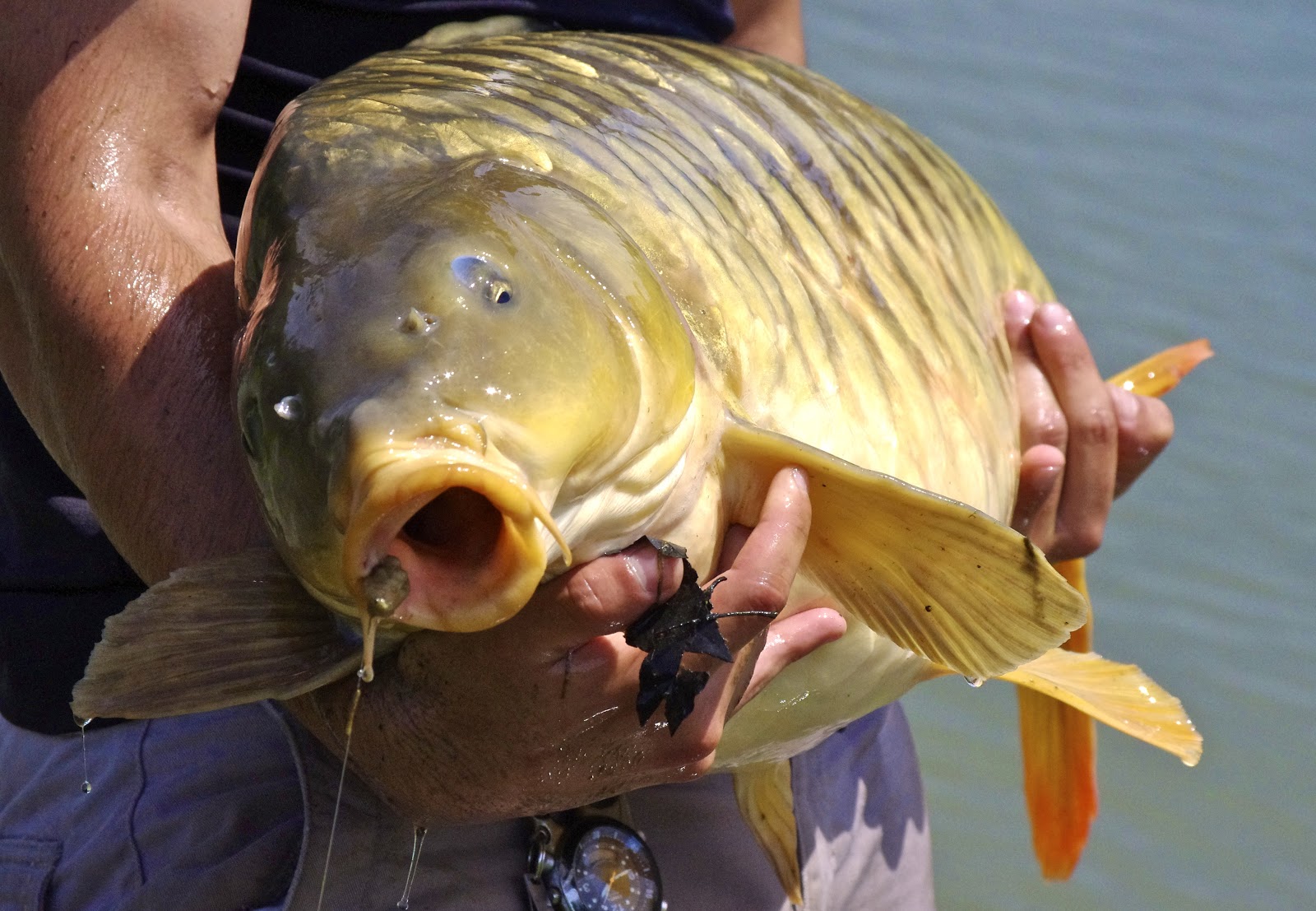
Looking pretty in a big guy's mouth...

Easily my second best producer and the fly responsible for almost all of my large fish. It is tied on a thin wire barbless czech hook and is basically weightless. My largest fish have been taken in deep water, 1-2 feet below the surface where this fly hovers. It can be tied with a lead under body or with bead chain eyes to adjust the sink rate and dap for bank feeders. For more information on how to fish it just read Adam's synapsis of "the damsel".

Be aware that this pattern is designed for still water carp. Fish found in areas with current will be able to put a lot more pressure on the hook than a still water fish.  This hook is designed for European nymphing and I use it because it is extremely light and slows the descent of the fly. Keeping this in mind, I have caught carp close to 30 lbs. on 3x using this pattern with no problems. I have never had a carp bend this hook but I am 100% positive that a big river fish will.


Shorter, Lighter, Arched, Different Materials, and an Epoxied Frame


Flooded bank caught fish...


I'll never forget having my damsel hovering on the edge of some floating weeds as this guy cruised beneath the flotsam completely unaware of my presence...


The Carp Crab
Gamakatsu Stinger B10S 4-6

This is a crayfish imitation designed to replicate a crawdad in the defensive position. It is as wide as it is long and is inspired by Diablo Crabs for saltwater species and several different popular carp imitations. The use of long webby Schlappen for the body material creates its width. It easily collapses on the descent and strip and juts out whenever stopped. It is heavily weighted by dumbbell eyes to get it down quick, ride hook up, and perform a slight headstand. It is designed to be used for large and aggressively feeding carp in rivers that are looking for a big meal. It can also be tied with a weed/snag guard for uneven terrain. 


Subtle UV Under-body


Mini-Version FTW


Flat Bottom


Defensive crayfish position.


River Carpin...


Weed/Snag Guard...