Monday, July 8, 2013

Small Stream Magicicadas


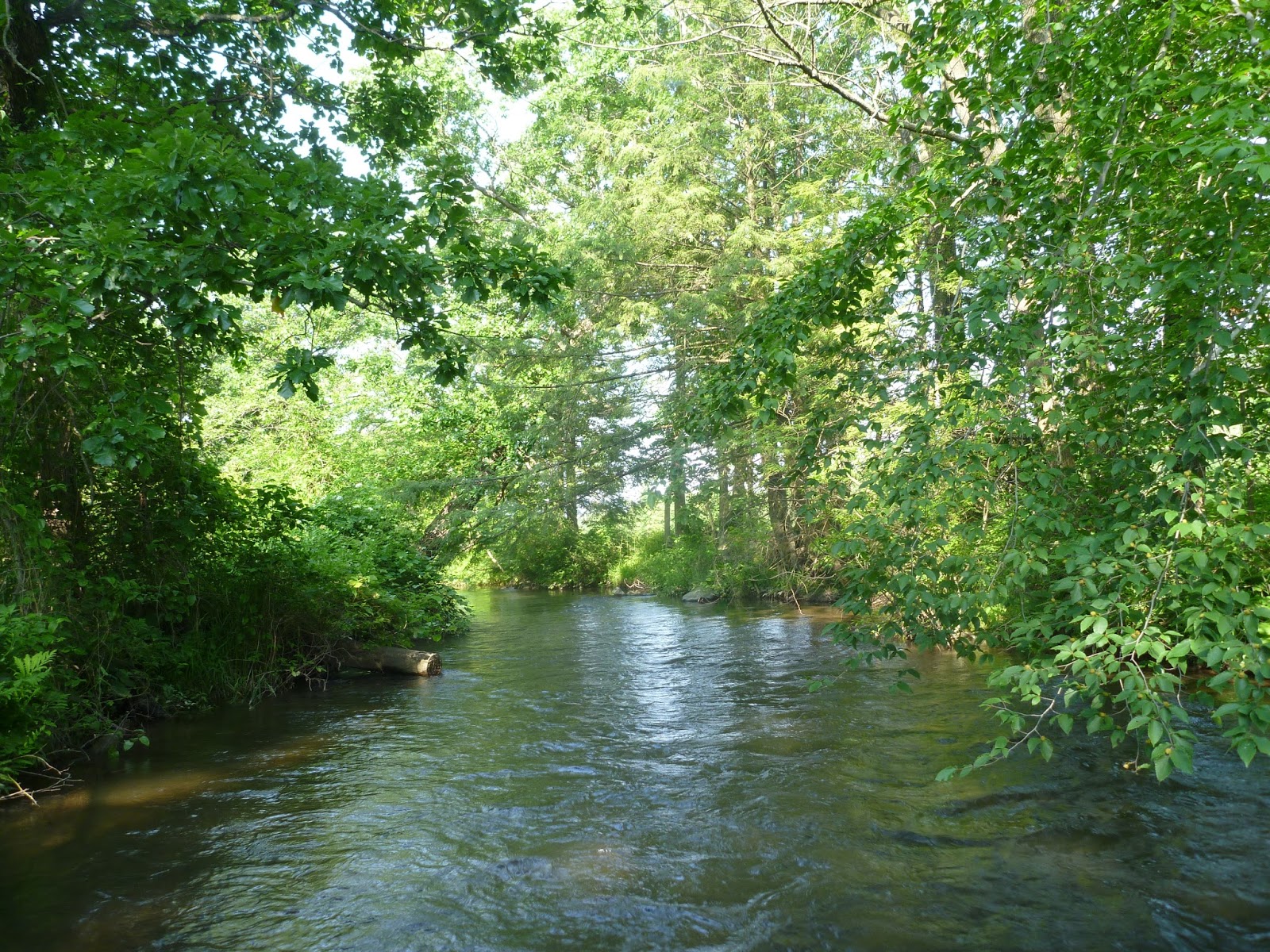
With the action for magicicadas slowing down considerably, I decided to check out a nearby small stream to see if it's resident trout were just as eager to hammer the 17-year insects. The nearby stream averages 5-10 ft. wide and has some very heavy cover. Packing a 9ft. 5wt. I was not prepared for some close quarters combat, but I had no other option. I also decided that the best way to fish the stream was to fish downstream. This allowed me to present my fly with a dead drift, using the current and slack line to feed the pattern downstream. A simple roll cast allowed me to re-present the fly with ease and decrease snags. I caught a mix bag of stocked and wild fish but managed to catch a brown, brook, and bow on top.


The next week, with magicicadas nearing their end, I guided my buddy Eric, who came up from Delaware specifically to catch a wild brown on a cicada dry fly. With a lot of water blown out from heavy rains, I took him to a spot that was miraculously uneffected by the rains. We ended up missing several takes by smaller fish. Defeated, I took him to a small stream that I had yet to target with cicada patterns. I took him immediately to the deepest pool on the stream and he caught a few fish that seemingly hit the dry flies as soon as they touched water. The majority of fish caught had bulging bellies where you could feel the indentations of cicadas in their stomachs. They were gorged.

Although not as rewarding as bigger fish on larger bodies of water, the small streams and small fish were just as exciting. Cicada fishing in general is just plain awesome.


Friday, July 5, 2013

You got to do what you got to do...

In one of my last posts I mentioned that my waterways have become fully choked with weeds and when a fish is hooked it streaks through the weeds like a down hill skier weaving through moguls. The only way I can land these fish is to dig them out with my feet and hand-line them to the surface. Here is a photo sequence of how to land a fish that has buried itself in the weeds...


- A special thanks to my cousin Ryan for providing the photos

Tuesday, July 2, 2013

Finding Brood II


When I arrived stream side for my first time fishing magicicadas, I could hear them in the trees. The noise was unmistakable and resonated from a hill covered in pines. The sci-fi sound came and went hourly throughout the day. Interestingly enough, the hill was the only section in the area where the sound was coming from. It was also where cicadas could be found in bushes, leaves, and littering the ground. Occasionally, you could even find a live cicada struggling as it floated downstream. Elsewhere,  you wouldn't even know that there were cicadas in the area. A half-mile downstream, I found another grouping of cicadas at the base of the mountain. In between those two areas is where I decided to concentrate my fishing efforts.

After my first cast into the stream, I knew I was in for a good day of fly fishing. A 17 inch wild brown gently sipped my size 6 cicada and the battle was on. As the day progressed, I had vicious attacks on my dry fly in every single good looking lie. On several occasions, fish would miss on their 1st, 2nd, and sometimes 3rd attempts before wising up to the folly at the end of my line. It was phenomenal fishing, and I was clearly the first person to toss a cicada on the stream. My brother finally got his act together and met me on the stream to catch a few beautiful browns of his own. Thunderstorms finally drove us off the water, but not before we were both satisfied with the action. We found out later that we weren't alone. Other anglers had keyed in on the insects as well and found success upstream of us.

When I fished the cicadas for the first time, I couldn't help but think about western hopper fishing. In Pennsylvania, terrestrial fishing can be good, but it never approaches the level of intensity of a western stream where trout hammer large hoppers along grassy banks every summer. It was nice to be able to experience something similar on my home waters and have some good sized wild browns willing to play in the middle of the day. Normally, summer days on streams like this are mostly hatch-less and the big trout don't show themselves too often. It was great to be able to experience it first hand.

Subsequent outings proved to be much less successful. Although eager to devour our large dry flies one day, future trips produced slow outings with the occasional nice fish. Waters nearby provided some action but everything failed to live up to that one afternoon. Myself and a few other anglers just timed it right and reaped the rewards. As the days went by, I began looking for other waters that held cicadas so I could replicate that experience of being the first to cast a cicada dry fly into a body of water.


Targeting areas of shade and structure proved to be highly effective...


Good male brown...


Fish also struck at the end of the drift as the cicada swung in the current...
Popping was effective too...


Sunday, June 30, 2013

Muddy Water Carping


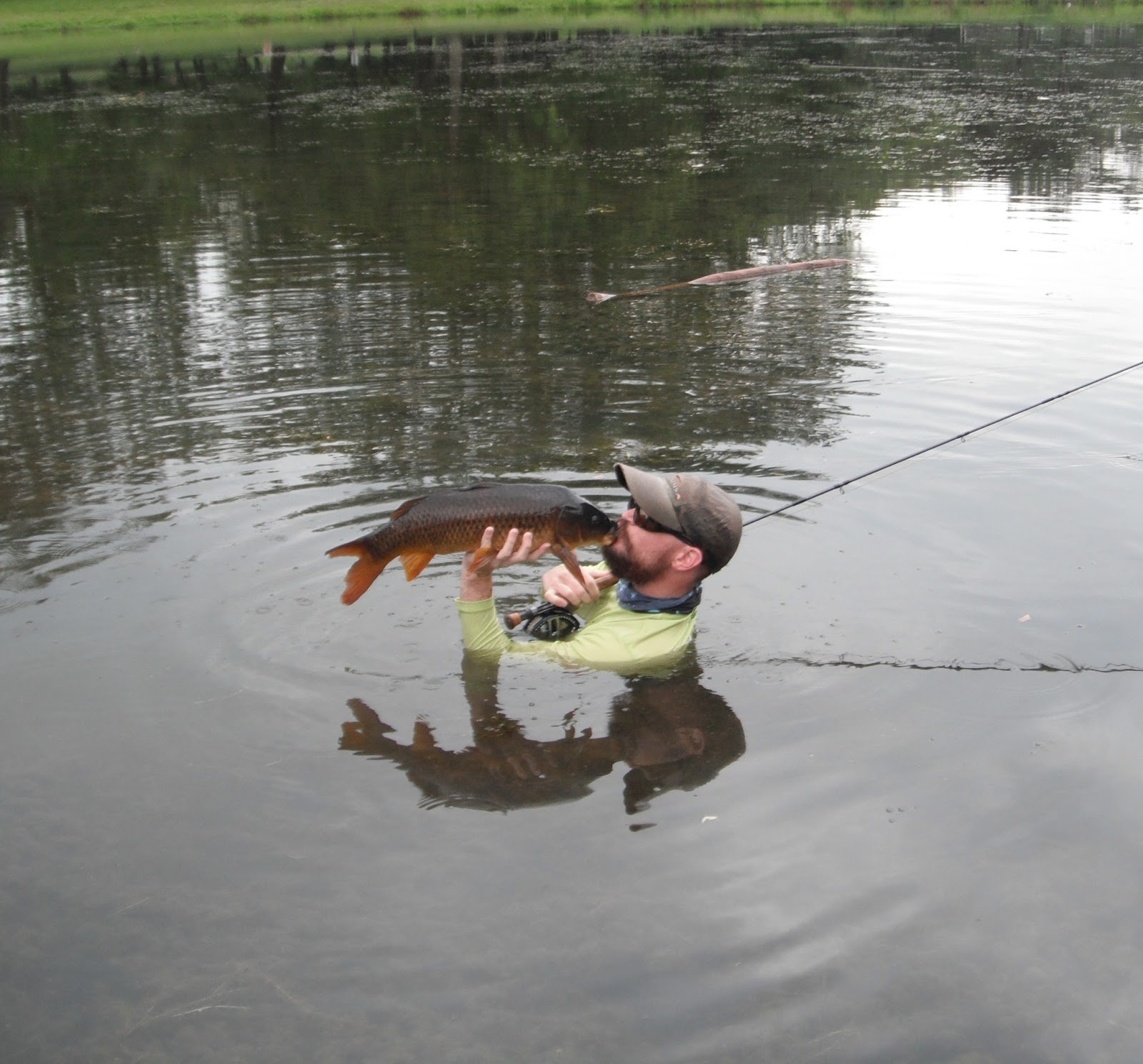
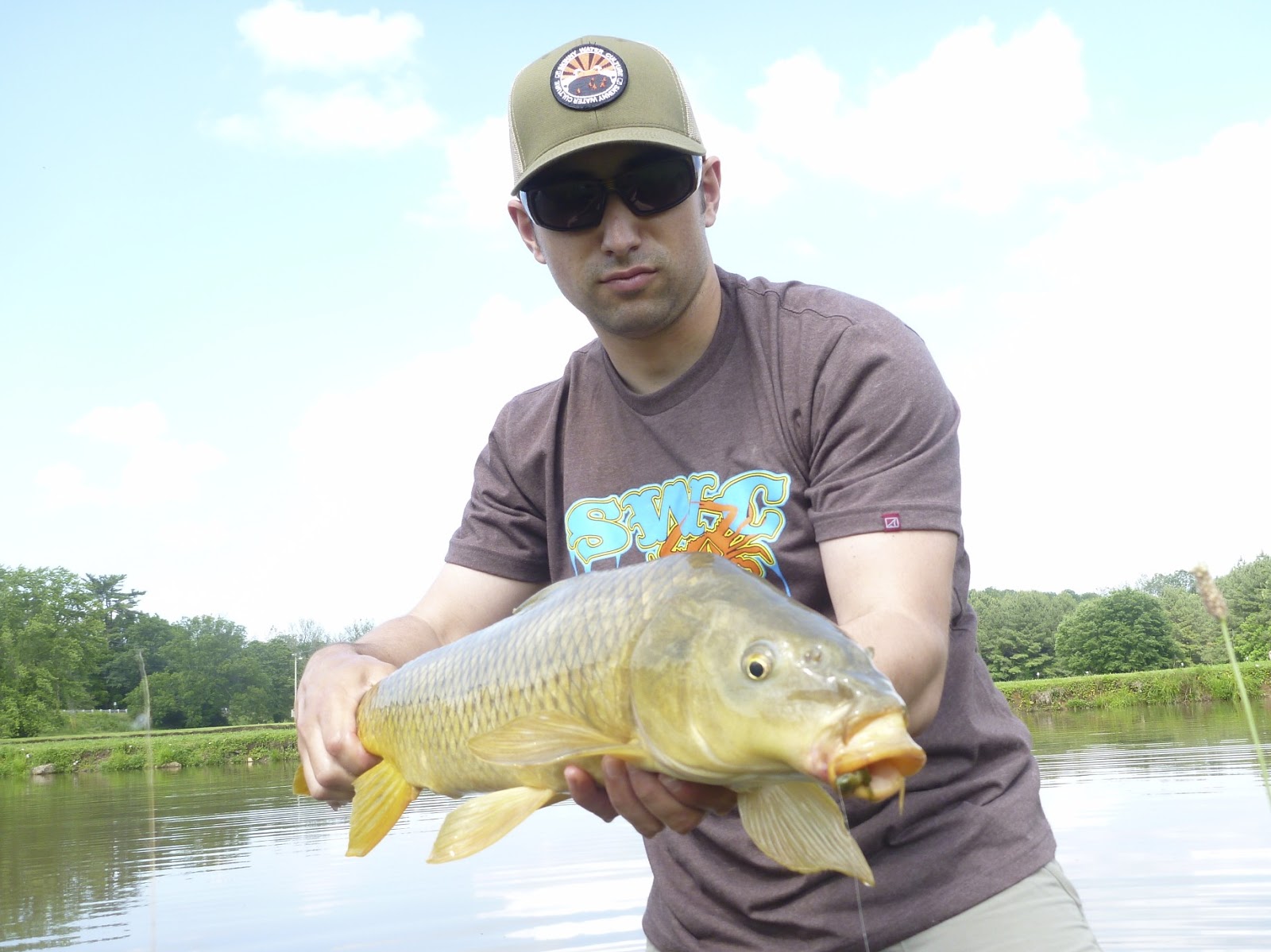
With the heat of summer upon us, it is also time for that annual threat, the severe thunderstorm. Looking at weather forecasts, it seems as if thunderstorms are expected to occur every single day. They come quick and dump an inch or more of rain in a few short hours. For trout streams, this is replenishment. To a warm water angler, this muddies things up a bit. Fishing the shoreline for carp usually improves, and you might even be lucky enough to fish a flooded area for a carp. For those of us that depend on sight fishing in clear water, things can get a bit tricky, especially for those fish feeding in the middle of a body of water. These techniques will help you to catch carp in muddy water while helping you develop a sixth sense.

During my first few years of targeting carp on the fly, the preferred strategy in muddy water was to throw on a strike indicator. Although a reliable option in certain circumstances and excellent at detecting a take, indicators also detect any contact with the line or fly. A take and a bump register the same way to an angler and in my experiences it can result in a lot of foul hooked or snagged fish. My technique began to change as my experiences molded a sixth sense, or ability to sense a take without actually seeing it occur. Since, I have come to rely on my sixth sense whenever targeting fish in muddy water.

In order to accomplish catching carp in muddy water, one needs to pay careful attention to the feeding activity of the fish. In high, muddy water, carp let their guard down and go on the feed. You'll often find them in places that they normally will not be. Since carp are almost impossible to see feeding in muddy water, you'll have to spot them by finding the evidence of their feeding. This most often occurs by spotting a mud trail or a steady plume of bubbles. Once spotted, you need to determine the direction that the carp is facing. This requires careful observation of their feeding movements and mud plumes/bubbles. If the water is shallow enough, you may even get a glimpse of a tail which is a clear giveaway. Once you see which way they are facing, look for a pattern. Are they staying in one spot, slowly making their way up a linear path, or going any direction they want? The latter is the most difficult to catch, but the first two are catchable.

Once you spot and observe the fish, the next step is the presentation. Whether you are tossing a stationary bottom fly, a mid-column fly, or a fly fished on the bottom, you can read the take the same way. When fish are actively feeding on  the bottom, they have their mouths in the muck and their senses are clouded by their disturbance. Once they are done, they will stop, pause, and continue, or they will move to a new spot to feed again. During these exchanges, when the fish stops or moves, is when they are susceptible to a fly. For this reason, I like to present my fly on the bottom, about 1-2 feet in front of the actively feeding fish. When the bubbles or cloud of mud stop rising from the bottom, you know the fish has paused or is looking to continue elsewhere. There is a few seconds of opportunity here when the fish will eat your fly.

If you are fishing a stationary bottom fly like a sucker spawn imitation your sixth sense is a prerequisite. Once the bubbles/mudding stops the fish can be on your fly. Usually there is a 1-5 second window where the carp can suck in your offering. If I think the carp is on the fly, I will tighten my leader/tippet and give a slow strip-strike. If this misses, I'll rarely spook the fish and since its slow, I am definitely not going to foul hook one. I will then wait until the fish begins mudding again and repeat the process. If  the slow strip strike is a success, I will continue the slow strike and the carp will feel the tension, bolt, and hook themselves.

If you are fishing a mid-column or bottom fly that requires action, the presentation is the same. Have the fly on the bottom or in the column at the moment the carp stops feeding. Give a short strip and pause to get the carp's attention. While rooting in the bottom, carp disturb aquatic invertebrates and will hunt them down. Having your fly flee the carp when he emerges from mudding is highly representative of the movement of its actual forage. In this case, you will feel the take after the strip.

Muddy water carping is not easy. A lot of time on the water and fly fishing for carp is needed in order to be able to read the body language of these fish and develop a sixth sense. The aforementioned strategies here are higher level techniques that can be very effective once mastered. They require a lot of patience, accuracy, and an acute awareness of carp behavior to work well.

Good luck.



Thursday, June 27, 2013

Magicicadas


Upon first hearing that the periodical magicicadas would be emerging en masse upon the eastern Mid-Atlantic region in 2013, I was pumped to say the very least. Months leading up to the brood II emergence, a day could not go by without me at least thinking about them and the possibilities in store. Having missed out on them in central Pennsylvania a few years back, I perused the internet looking at videos and reports from previous emergences and day dreamed of pods of carp and trout rising to feast upon the hapless insects. One particular article on the event claimed that an estimated 1 trillion of the cicadas were expected to serenade us with their presence. Needless to say, my hopes were sky high and bound to be disappointed.


As reports started to emerge in late May, I took to the vice to concoct a pattern that I hoped would work. As the days went by, I texted friends/family and browsed social media outlooks looking for any sign of activity in my area. There was nothing. As the weeks went by and into June, I began to doubt that I would be able to cast my flies at much of anything. There was nothing to be heard of, save for some scattered and isolated internet rumblings. My mind began to question whether the late spring frosts or flooding had anything to do with the delay or lack of an emergence. As the third week of June began, I was out on a golf outing with the entire family and the insect I had been dreaming of flew over the tee box. It was about to go down.


As it turns out, they had emerged after all and I was just looking in the wrong places. I was waiting for the bugs to come to me when I had to go to the bugs. Driving around and listening for the twilight sound of cicadas (think the movie Them) became a daily activity. Talking to fellow fishermen for advice and whereabouts became another. My dreamlike expectation of having magicicadas emerging everywhere and drowning out conversations was a mirage. They are actually extremely isolated (in my area) where certain sections of a stream have them while other sections do not. One side of a mountain could be alive with cicadas while the other won't have any. Most developed areas are devoid of the magicicada and then you can drive into a town and they are bouncing off your windshield. They are here and there but not everywhere.


My high hopes produced unrealistic expectations and I have since been brought back to reality. There aren't a trillion cicadas out there, but there are a lot, and you just have to find them. All the fish in the river aren't going nuts for them but there are fish gorging themselves and willing to hammer a size 6 dry fly. For those willing to go and find them, you will experience some outstanding fishing. However, you might just have to get out of your comfort zone and explore some new areas.


Beat to Hell
Teeth Marks Courtesy of Wild Browns...