Sunday, May 17, 2009

8 Shooter.


Adam and I hit up the White Clay creek system this past weekend and caught eight different species. With high water and low visibility we threw streamers for two days but were able to transition to dries and nymphs as the water cleared on the second day. All told we caught browns, rainbows, fall fish, smallmouth, rock bass, pumpkinseed sunfish, suckers, and a snapping turtle. The snapper was sight fished to and attacked an olive woolly bugger twitched along the bottom.

Small Hook Jaw.

White Clay Scenery.

Fall Fish or "CHUB"

Cream Cahill

Black Tipped Rock Bass.

Log Jams = Big Fish

More White Clay Scenery.

Slaying Fish In Clearing Water.

Bow out of a Root Ball.

Possible Native.

Snapping Turtle Coming To Hand.

Blue or Red Quill?

This Bow has a Purple Marabou Comb Over.

Black Woolly Buggers = Success

Smallmouth Fight Hard.

Blue or Red Quill?

Monday, May 11, 2009

New Water.


A change of scenery is always welcomed, especially on trout streams. The same freestone streams can only offer so much when you want so much more. When looking for new water, you often have to go a ways to find a change of pace. I found this change in the Gunpowder River, located near Baltimore, MD. My brother Matt, began fishing the Gunpowder when he took up a teaching job in inner city Baltimore. I put off heading there to fish with him for almost two years. After finally getting down there and experiencing it for myself, I can say that I immediately regret those two years.

Dream Hole.

Go Deep or Go Home.

Midges.

Not That Colorful...

The road into the Gunpowder tailwater, takes you down a long winding corridor flanked by forest that exhibits a feeling seldom found so close to Baltimore. The feeling grows with new leaves on the trees and the smell of fresh rain. Down the road, we pull off and gear up. It's 7 a.m. and it is pouring outside. The forecast for the day calls for rain, rain, and more rain but I am in good spirits. Rain is my favorite time to fish. We hike down a nice trail into the small canyon. Its a fairly good walk before I finally lay eyes on the stream. All it takes is one look through the rhododendrons and I know I am about to experience a special stretch of water.

Pocket Water.

Hard Fighting Bow.

Slinging it in the Rain.

Fell For the Zebra Midge.

Stepping up to the first hole, I am in heaven. Its a deep plunge pool with large boulders on either side. The hole is accentuated by large fallen trees courtesy of the beaver population. Looking up stream, each hole seems to only get better. Within the first few casts, small browns and bows come to hand. The situation repeats itself for the next several hours occasionally interrupted by a slam pig sighting that keeps us on our toes with anticipation. The hoss's elude us for the day but we know they are there. They will have to wait until the next time I am able to escape to this beautiful stream. However, next time, I won't be waiting two years. More like, two weeks.

Camo.

In Good Company.

Welcome To The Gunpowder.

Saturday, May 2, 2009

The Return of the Indian.

The Browns Are Back.

Home waters hold a special place in all fly fishermen's hearts. These waters are often where we honed our craft learning how to cast, mend, fight, and land fish. They are usually the spot where we landed our first trout on fly fishing tackle and our first trout on a fly we tied all by ourselves. These firsts, are some of the defining moments in a fly fishermen's career. It is these moments, on our homewaters, that we cherish most. In these moments we develop a lifelong passion that eventually becomes an addiction.

Home Water.

Little Caddis House on the Rock.

Primary Food Source.

I can still remember my first trout on the fly. I had just turned 13 and had received a new outfit for my birthday. That evening, I geared up and headed with my father down the street to the local creek. I had tied on a prince nymph from some assortment that came along with the outfit. I began fishing the deep pool under the bridge. I had no luck, but I remained patient and persistent. As the sun faded behind the trees, I turned my attention to a small riffle at the head of the pool. At this moment I did not have the ability to read water and the spots where trout often hold, so I had no expectations for where I was about to cast. It was only a few inches deep, but I cast anyway. My fly landed along the edge of the riffle and as my leader and line drifted back towards me they suddenly paused. I lifted the rod to set the hook and on the other end a small rainbow began fighting back.

Young of the Year.

Beautiful Brown.

Since then, I have had many more moments on my homewater, Indian Creek. In ten years I have witnessed the rise and fall of its bounty. Each year environmental factors such as floods change the landscape of the small stream filling in previously deep pools and creating new holding water behind log jams. I have also witness the effects of development on the wild brown population. Over the past few years their numbers had dwindled. An outing would often yield zero native fish. I stopped fishing the Indian and reserved it for special moments once or twice a year just to see how it was doing. Over my spring break, I returned to the Indian and was astonished to find that the browns were back and they were larger, prettier, and smarter than ever. On my last outing, I landed one of the largest browns I have ever caught out of the Indian. In small riffle under a heavy canopy of evergreens, I drifted my flies along an edge of slate. Out from under the slate, the big brown emerged and gently took my caddis. He put up an amazing fight on my 2wt before coming to hand.

Landed in the Rain (the best time).

Nice Fins.

Full of Caddis.

I Was Pumped.

Release.

Powering Away.

Back To His Lair.

Saturday, April 25, 2009

Maps and Mazes...

Shenandoah National Park is a short two-hour drive from Baltimore so my girlfriend and I drove down for a quick get-a-way during the 2nd week of April. I took my new 3wt and was eager to hook into some wild brookies. I strung up my 5wt for Stacy, hoping these two days would provide her with some willing trout.
We decided on an 8 mile hike along the White Oak Canyon trail. The stream we encountered began as a literal seep from under a car-sized boulder. Within a half mile it joined another miniscule stream and plunged over an 8ft slide into the first reasonable plunge pool. We stopped and strung up.

The temperature was around freezing and it was pretty early in the AM. Some tricky casting around overhangs yielded 3 takes but no fish brought to hand. We had a long hike ahead and decided to move on.

The stream slowly grew in size and soon we were into an amazing stretch of waterfalls and boulders and slides and pools. We landed our first tiny fish by kneeling on approach to a small hole.


We kept moving downstream, stopping at each attractive spot and taking a few casts. We began to land brookies from each and every pool. The farther we moved downstream, the larger the fish became. At about this point they topped out at around 6 inches.

We soon came to the reason this trail is one of the most heavily traveled in the park. A combination waterfall-slide with a combined length of about 130ft. We hiked to an overlook and stared for a while at the rushing water. We then spied a small car-sized pool formed by the waterfall about 30ft from the top of the falls. We hiked down to it.


Stacy took a few pics while I cast into the boiling water. In two casts I landed a 9 inch brookie. It might have been the prettiest fish I've ever seen.


I then brought in 4 more from the same pool. I was stunned how the entire existence of these fish takes place in a 3ft deep pool sandwiched between a 100ft near-vertical slide and a 30ft waterfall.

We doubled back around and climbed down to the bottom of the slide and made our way towards to main pool at the bottom. I missed 4 fish and called Stacy up from a lower pool to try her luck. On her 2nd cast she hooked into a genuine slam-pig. She deftly played the fish as I took a running leap over the torrent of water to help her land it. I hoisted the 12incher from the water, we stared for a few seconds, snapped a pic, and released it.


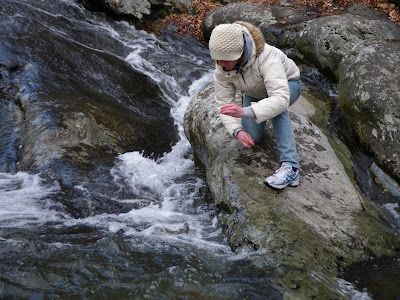

The wild brookies of Shenandoah are a treat. Easy to catch and ridiculously pretty, streams that harbor them deserve total protection. It was a great day catching them with Stace and I'll never forget the slammer she pulled out of the giant waterfall's plunge pool. After that fish, with the sunset approaching and a long, uphill hike to the car, we packed up and headed up more than 1,000 vertical feet to the parking lot.


There is something about catching a fish in the place it evolved to inhabit that renders all thoughts of stocked hatchery fish an insult. Especially brookies with greens and oranges that exist nowhere else on Earth beyond the backs and fins of the fish in this particular stream. With their perfectly formed fins and amazing patterns, I am reminded of Cormac McCarthy's closing paragraph in his novel, The Road; "Once there were brook trout in the streams in the mountains. You could see them standing in the amber current where the white edges of their fins wimpled softly in the flow. They smelled of moss in your hand. Polished and muscular and torsional. On their backs were vermiculite patterns that were maps of the world in its becoming. Maps and Mazes. Of a thing which could not be put back. Not be made right again. In the deep glens where they lived all things were older than man and they hummed of mystery."
Wednesday, April 22, 2009

Groundhog vs. Goose


For those of you whoever wandered why the Discovery Channel never aired Groundhog vs. Goose, this is for you. Searching for golden bones water often proves to be futile, especially where I live. More often than not you find other things to take up your interest like this groundhog, whose only option while scaling a slate cliff is to run by mother goose.

The Approach.

She Is Not Thrilled.

Groundhog Stands No Chance.

Mr. Groundhog resorted to climbing a nearby tree, something I never knew they could do.

Geese scare the shit out of me while I am fly fishing atleast three times a year. They are perfectly camouflaged on their nests alongside trails or streams and they always seem to freak out as your about to step on them. Often this is by complete surprise and the silence is broken by an annoying quack, and a pestering hiss. I sympathize with Mr. Groundhog.